Threads
A real helical thread on a shaft or in a hole: ISO metric, inch, trapezoidal and ACME, buttress, pipe threads, lamp bases, bottle necks. How to recognise one on a real object, every parameter, and how to print it.
A thread is the spiral ridge that lets a screw turn into a nut. Its pitch is the distance from one ridge to the next, measured along the axis; the crests are the tops of the ridges. A male thread is outside a shaft (a bolt), a female one inside a hole (a nut).
Choosing a thread
A printed thread is worth making when the part screws onto something that already has one (a tap, a hose, a bottle, a camera, a pipe), or when screwing is the point (a lid, a lead screw, a knob that tightens). To hold printed parts together with small screws, M2 to M5, a printed thread comes out too fine: a hole with ribs the screw cuts its own thread into (hole(M3, 8.mm, "ribs")), a heat-set insert or a self-tapping screw holds better: see the guide on holes. For a part that screws onto a real thing, never guess its thread: measure it (next section).
By what it does:
| Thread | Use it for | Found on |
|---|---|---|
ISO metric coarse "M8" |
holding parts together: the default | most things in Europe |
ISO metric fine "M8x1" |
fine adjustment, thin walls | lens rings, bicycles |
Unified inch "1/4-20 UNC", "1/4 UNF", "#10-32" |
meeting American things | cameras and tripods (1/4-20, 3/8-16) |
Trapezoidal "Tr12x3", ACME "1/2-10 ACME" |
moving a load | vices, lathes, 3D printers' Z axis |
Buttress "S20x4" |
a load one way only | presses, big caps |
BSP parallel "G1/2" |
pipes sealed by a gasket on a face | taps, hoses, showers, filters |
BSP tapered "R1/2", "1/2 NPT" |
pipes sealed by the thread | plumbing, gas, compressed air |
Edison "E27", "E14" |
lamp bases and sockets | bulbs |
Necks "28-400", "PCO 1881" |
caps for bottles and jars | cosmetics, lab bottles, soft drinks |
Garden hose "3/4 GHT" |
American hoses | US taps (in Europe: G3/4) |
The rule of thumb: water or air goes through it, a pipe thread (G, R, NPT); it holds parts together, ISO metric. G1/2 (⌀20.96) and M20 look alike and do not mix.
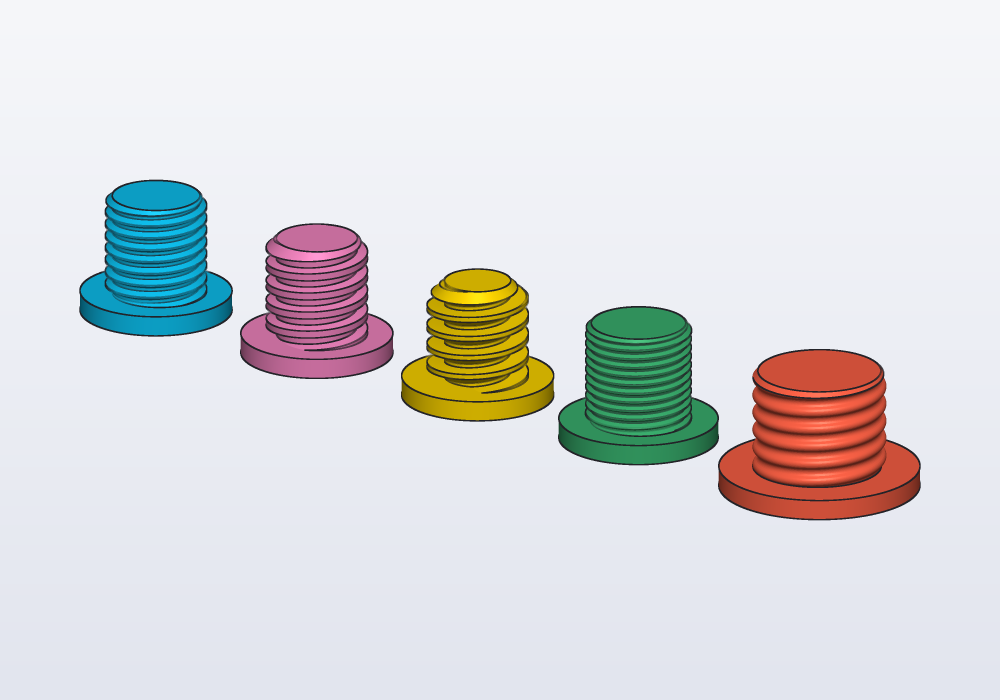
The teeth differ in shape (their profile: the outline of one tooth cut along the axis). Side by side, the same 20 mm shaft cut with five of them:
// one shaft per family, each with the thread's own
// profile

Solid shaft(Length d) => cylinder(d: d * 1.5, h: 4.mm)
    + cylinder(d: d, h: 20.mm).move(z: 4.mm);

@part("Sky Pop")
Solid iso() => shaft(20.mm)
    .thread(faces.largest, "M20");

@part("Pink Pop")
Solid trapezoid() => shaft(20.mm)
    .thread(faces.largest, "Tr20x4")
    .move(x: 40.mm);

@part("gold")
Solid buttress() => shaft(20.mm)
    .thread(faces.largest, "S20x4")
    .move(x: 80.mm);

@part("mediumseagreen")
Solid pipe() => shaft(20.955.mm)
    .thread(faces.largest, "G1/2")
    .move(x: 120.mm);

@part("tomato")
Solid edison() => shaft(26.45.mm)
    .thread(faces.largest, "E27")
    .move(x: 165.mm);
Recognising a thread on a real object
To screw something onto a real part, measure it:
- The outer diameter of the male thread, over the crests, with calipers (a sliding gauge that measures to a tenth of a millimetre). From a female one: its inner diameter plus about twice the tooth's depth, or try a known screw in it.
- The pitch: count the crests over 10 mm (pitch = 10 / count), or over an inch, 25.4 mm (threads per inch). A thread gauge (a set of toothed blades, one per pitch) gives it at once.
- A taper (a thread that narrows, like a cone): a diameter different near the tip and near the base means R or NPT.
- How it seals: a gasket or an O-ring on a flat face, G; PTFE tape on the threads, tapered.
- Match the table:
| Outer diameter | Pitch | Thread |
|---|---|---|
| 6.35 mm | 1.27 mm (20/inch) | 1/4-20 UNC (cameras) |
| 9.53 mm | 1.59 mm (16/inch) | 3/8-16 UNC (tripod heads) |
| 13.16 mm | 1.34 mm (19/inch) | G1/4, R1/4 |
| 20.96 mm | 1.81 mm (14/inch) | G1/2, R1/2 (taps, showers) |
| 21.34 mm | 1.81 mm (14/inch) | 1/2 NPT |
| 26.44 mm | 1.81 mm (14/inch) | G3/4 (garden taps, washing machines) |
| 26.45 mm | 3.63 mm, round | E27 (bulbs) |
| 27.43 mm | 2.7 mm | PCO 1881 (PET bottles) |
| 27.38 mm | 4.23 mm (6/inch) | 28-400 (bottles) |
| M sizes | 0.5 (M3), 0.7 (M4), 0.8 (M5), 1 (M6), 1.25 (M8), 1.5 (M10), 1.75 (M12), 2 (M16) mm | ISO metric coarse |
The full list of the sizes known is under Threads: choosing one, recognising one in the language reference.
Cutting a thread on a face
body.thread(face, size) threads a cylindrical face of a solid: it cuts the spiral groove into the face already there. Make the cylinder first, at the right size:
- a shaft at the thread's nominal (major) diameter, the size it is named after, measured over the crests: ⌀8 for M8;
- a hole at the tap drill, the hole drilled before a thread is cut in it: about the nominal diameter less one pitch, ⌀6.8 for M8, ⌀17.5 for M20.
A cylinder far from the thread's size is an error that says what it wants. The thread starts from the free end: the tip of the shaft, the opening of the hole.
// a printed M12 bolt and its nut

@param("Play of the nut (each side)", min: 0.1.mm,
    max: 0.5.mm)
immutable play = 0.2.mm;

// a hexagon 19 mm across the flats, the spanner size
Profile hex() => polygon(6, d: 19.mm, fit: "sides");

@part("Sky Pop")
Solid bolt() => (hex().extrude(8.mm)
        + cylinder(d: 12.mm, h: 30.mm).move(z: 8.mm))
    .thread(faces.largest, "M12");

@part("Pink Pop")
Solid nut() => (hex().extrude(10.mm)
        - cylinder(d: 10.3.mm, h: 30.mm, center: true))
    .thread(faces.largest, "M12", clearance: play)
    .move(x: 30.mm);
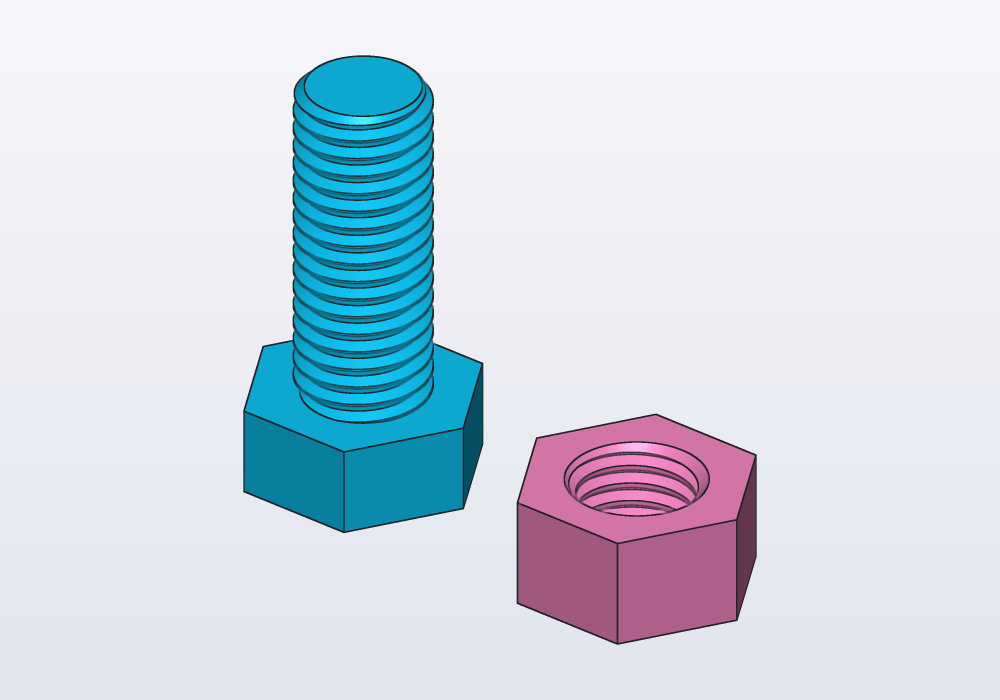
Picking the face: here the threaded cylinder is the largest face of each part; when it is not, faces.filter(f => f.area > …) or a face picked in the 3D view (right-click it, below).
The parameters
| Parameter | What it does | Default |
|---|---|---|
size |
the standard, by name: "M8", "M8x1", "1/4-20 UNC", "Tr12x3", "G1/2", "28-400"… |
— |
pitch: |
alone: an ISO 60° thread of that pitch on the cylinder's own diameter; with a size, overrides its pitch | the size's |
length: |
how much of the face is threaded, from the free end | the whole face |
turns: |
the same, in turns (turns: 1.5 for a 410 bottle neck) |
— |
flip: |
start from the other end | false |
starts: |
multi-start: that many threads side by side, the lead starts × pitch |
1 |
left: |
left-handed | false |
clearance: |
play each side (a small gap so the parts turn freely), for printed parts | 0.15.mm in holes, 0 on shafts |
chamfer: |
the 45° bevel at the free end, to start the screw | true |
taper: |
the angle each side leans from the axis: a conical thread | R and NPT 1.79°, others 0 |
Starts
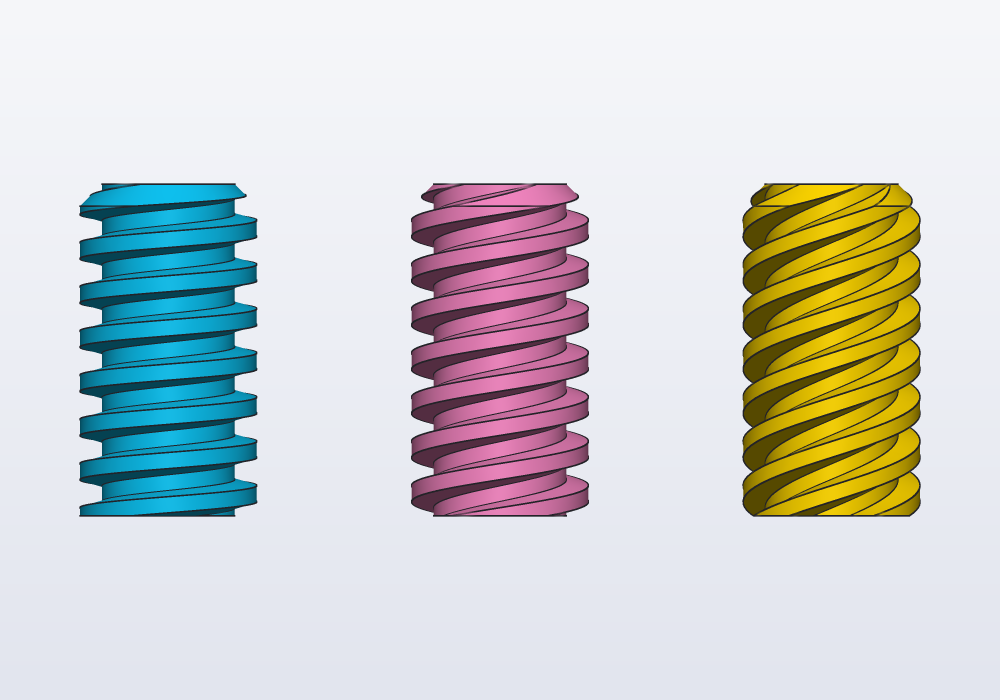
A lead screw that moves fast, or a lid that closes in a quarter turn, has more threads side by side, wound together like the stripes of a barber's pole. With starts: 2 each turn advances two pitches: the lead, how far one turn moves, is twice the pitch. The teeth stay the same size.
// one, two and four starts: the same tooth, the lead
// 1, 2 and 4 times the pitch

Solid rod() => cylinder(d: 16.mm, h: 30.mm);

@part("Sky Pop")
Solid one() => rod().thread(faces.largest, "Tr16x4");

@part("Pink Pop")
Solid two() => rod()
    .thread(faces.largest, "Tr16x4", starts: 2)
    .move(x: 30.mm);

@part("gold")
Solid four() => rod()
    .thread(faces.largest, "Tr16x4", starts: 4)
    .move(x: 60.mm);
Tapered threads
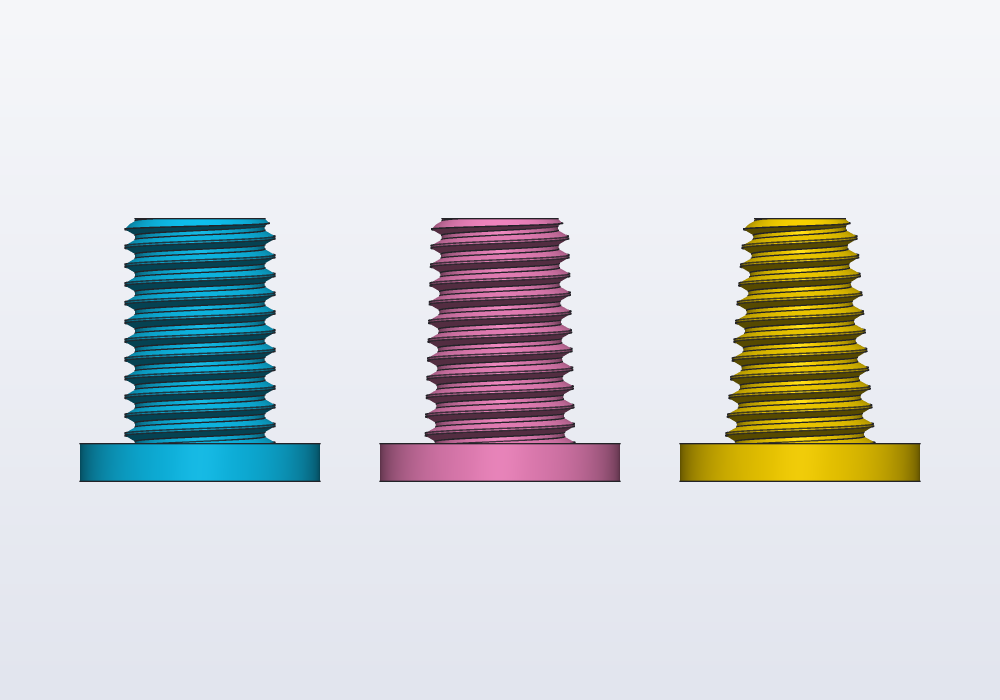
R and NPT pipe threads narrow by 1 in 16 on the diameter (1.79° each side): screwed in, they wedge tight and seal. taper: makes any thread conical; taper: 0.deg makes R or NPT parallel. The nominal size stays at the fixed end, and the thread narrows towards the tip of a shaft or deeper into a hole.
// an M20, parallel, tapered like a pipe thread, and
// steeply tapered

Solid shaft() => cylinder(d: 32.mm, h: 5.mm)
    + cylinder(d: 20.mm, h: 30.mm).move(z: 5.mm);

@part("Sky Pop")
Solid parallel() => shaft()
    .thread(faces.largest, "M20");

@part("Pink Pop")
Solid pipeLike() => shaft()
    .thread(faces.largest, "M20", taper: 1.79.deg)
    .move(x: 40.mm);

@part("gold")
Solid steep() => shaft()
    .thread(faces.largest, "M20", taper: 5.deg)
    .move(x: 80.mm);
Two threads on one bolt
Every thread is at the same angle at its free end, so a shaft and a hole threaded from the same free end mesh, whatever their lengths. That is how to make a nut that runs on a bolt: thread a tube over the bolt's whole length, from the same tip, and take the nut out of it where it should be. The Examples menu's Dual-thread bolt (examples/11_dualthread.hcad) goes further: its shank carries an M24 right-handed and a Tr24x5 left-handed thread at once (the shank cut by both, threaded("M24", false) & threaded("Tr24x5", true)), and two nuts, one on each thread, screw down it turning opposite ways. Tightened against each other they lock: what would loosen one tightens the other. Its unittest checks that both nuts run free, at any turn of the "Turn the nuts" parameter.
Loose threads: the threads library
thread() cuts a face that is already there. The threads library makes a loose threaded rod, or a tool to subtract:
// an M8 rod 40 mm long, and an M8 thread cut 12 mm
// into a block

import std;

@part("Sky Pop")
Solid rod() => threadedRod(8.mm, 1.25.mm, 40.mm);

// tappedHole goes down from z = 0: moved up to the
// block's top face
@part("Pink Pop")
Solid block() => (box(20.mm, 20.mm, 15.mm)
        - tappedHole(8.mm, 1.25.mm, 12.mm)
            .move(z: 15.mm))
    .move(x: 30.mm);
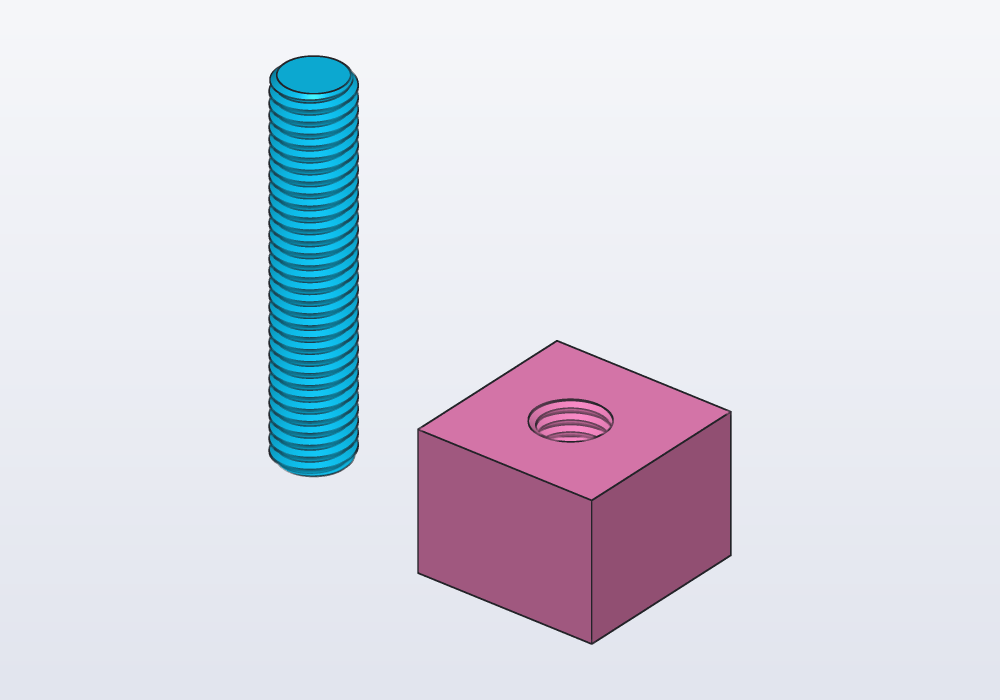
tappedHole(d, pitch, depth, clearance:, left: true) is the hole for a left-handed screw, as threadedRod(…, left: true) is the screw. isoThread(d:, pitch:, length:, chamfer:) is the builtin underneath, an exact ISO thread. For anything that is not an ISO metric thread, or for starts and tapers, use thread() on a cylinder.
Keeping it quick
A thread on a shaft is built straight from its faces and joined to the part by hand, with no boolean on its helical faces; so is a thread in a hole, through or blind, as long as the hole or shorter: a pocket of a few flat sides is cut round it, and a sleeve, flat outside and threaded inside, built from its faces, is sewn in where its flat sides lie on the pocket's, its end on the pocket's floor. Both are two to ten times quicker than cutting the thread with a boolean, and the same solid. Tapered threads are cut the boolean way.
Printing threads
- Under M5 they print badly: try a hole with ribs first (
hole(M3, depth, "ribs"): three ribs along the hole that the screw cuts its thread into, see the guide on holes), or use a heat-set insert (a brass sleeve with a thread inside, melted into the plastic with a soldering iron) or a self-tapping screw (one that cuts its own thread). - M6 to M12 print well standing up, with 0.15 to 0.3 mm of play (
clearance:). Print a short test piece first: printers differ. - A lid that opens often wants a coarse pitch (2 to 4 mm), and more starts for less turning.
- Caps for bottles: 0.3 to 0.5 mm of play, in PETG (it flexes onto the neck's seal, where PLA cracks). A 400 neck has about one turn of thread, 410 one and a half, 415 two:
turns:. - Lying on its side a thread comes out rough on its underside (the teeth hang over empty air while they print): print threaded parts standing whenever you can.
Common errors
| Message | What to do |
|---|---|
| the shaft is ⌀7 mm: a M8 thread wants ⌀8 mm | make the shaft at the nominal diameter |
| the hole is ⌀8 mm: a M8 thread wants a hole of about ⌀6.9 mm (the tap drill) | make the hole at the tap drill, not at the nominal size |
| the size names a thread… | the name is not known: the message lists the forms that are |
| the face is only part of a cylinder | a thread needs the whole circle: thread before cutting a flat or a slot |
| the faces are not one cylinder | the selector caught two cylinders: filter them apart |
| a taper of …° narrows the thread to nothing | a smaller angle or a shorter length |
In the application
Right-click a cylindrical face in the 3D view: Surface › Thread (outside) on a shaft, Surface › Thread (in the hole) in a hole, lists the sizes that fit that diameter. Choosing one writes the .thread(…) line in the code, where you add starts:, clearance: and the rest.