Enclosures and boxes
Boxes, trays and cases with lids: the enclosures library (roundedBox, tray, enclosure(…).base and .lid) and every option of it, boxes hollowed with shell() or cut in two, screw bosses, ventilation slots and holes, and a worked example of a case for a circuit board.
The enclosures library
The enclosures library (import std;) gives three functions, each built on the one before: a block with rounded vertical edges to start from, an open box (a tray, a drawer), and a closed case whose lid screws on. For a lid that snaps on or sits flush, Examples › Box with lid in the application is a ready start.
import std;

// the library's three shapes, side by side

@part("Sky Pop")
Solid block() => roundedBox(40.mm, 30.mm, 20.mm, 5.mm);

@part("Pink Pop")
Solid open() => tray(40.mm, 30.mm, 20.mm,
        wall: 2.mm, r: 5.mm)
    .move(x: 55.mm);

@part("gold")
Solid base() => enclosure(vec(40.mm, 30.mm, 20.mm))
    .base
    .move(x: 110.mm);

@part("mediumseagreen")
Solid lid() => enclosure(vec(40.mm, 30.mm, 20.mm))
    .lid
    .move(x: 165.mm);
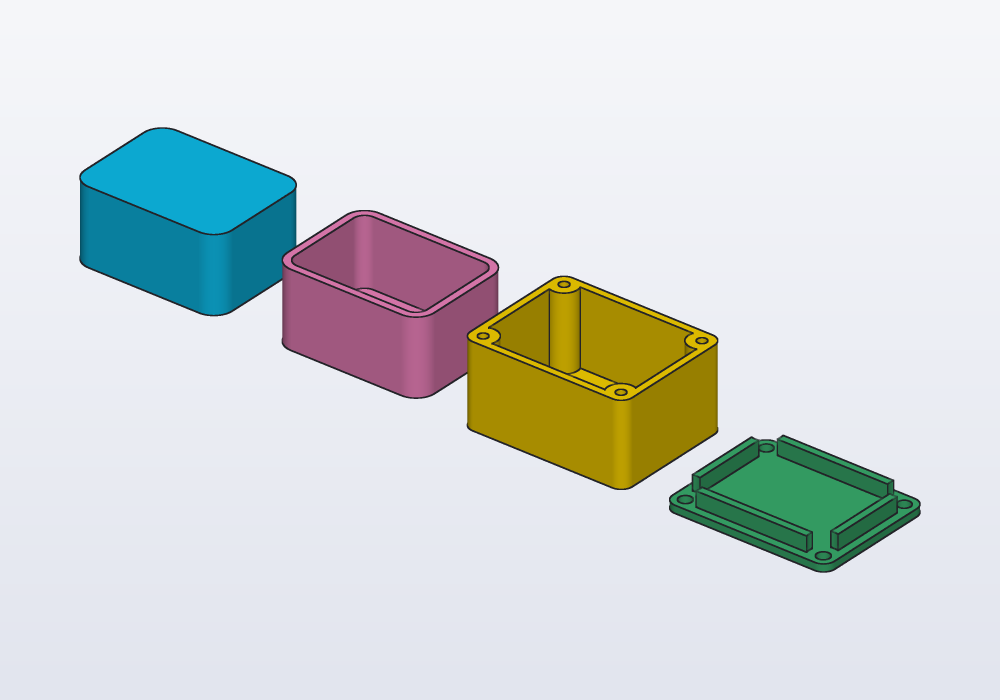
roundedBox and tray
roundedBox(x, y, z, r) is a box centred in X and Y, standing on z = 0, its four vertical edges rounded by r (3 mm unless given). tray(x, y, z, wall:, r:) is that box hollowed from the top: the outside measures x × y × z, the walls and the floor are wall thick (2 mm unless given), and the inside corners are rounded by r - wall.
The faces you are likely to come back to carry a name, a tag: a tray's or a base's rim, where the lid rests, enclosures.rim, its floor inside enclosures.floor, a lid's lip enclosures.lip. A boss on the floor, a chamfer round the rim, find them by it: .chamfer(edges.of(faces.tagged("enclosures.rim")), d: 0.4.mm). See Selectors and features.
| Parameter | What it does | Default |
|---|---|---|
x, y, z |
the outside size | — |
r |
radius of the vertical edges outside | 3.mm |
wall (tray only) |
thickness of the walls and the floor | 2.mm |
The radius must be less than half the narrower side, and not equal to the wall: a wall thinner than r leaves round corners inside, a thicker one sharp ones.
The sizes that matter come from what goes inside: measure it first, then add the room round it. Here the thing is Carlo, the mascot clip, and the tray takes its size from Carlo's own (bbox, the smallest box round a solid), with a millimetre of room all round. Carlo goes in as a reference part (export: false): shown, never exported, and a unittest (checks that run with the model) proves it fits:
import std;

// a tray for Carlo, sized from Carlo itself

@param("Play round Carlo", min: 0.2.mm, max: 2.mm)
immutable play = 1.mm;

immutable wall = 2.mm;

// the clip, centred on the origin
Solid clip()
{
    auto c = carlo();
    immutable mid = c.bbox.center;
    return c.move(x: -mid.x, y: -mid.y);
}

@part("Sky Pop")
Solid holder()
{
    immutable size = clip().bbox.size;
    return tray(size.x + 2 * (play + wall),
        size.y + 2 * (play + wall), size.z + wall,
        wall: wall, r: 4.mm);
}

// Carlo inside, on the floor: shown, not exported
@part("Pink Pop", export: false)
Solid inside() => clip().move(z: wall);

unittest
{
    assert((holder() & inside()).volume == 0.mm ^^ 3,
        "Carlo does not fit");
}
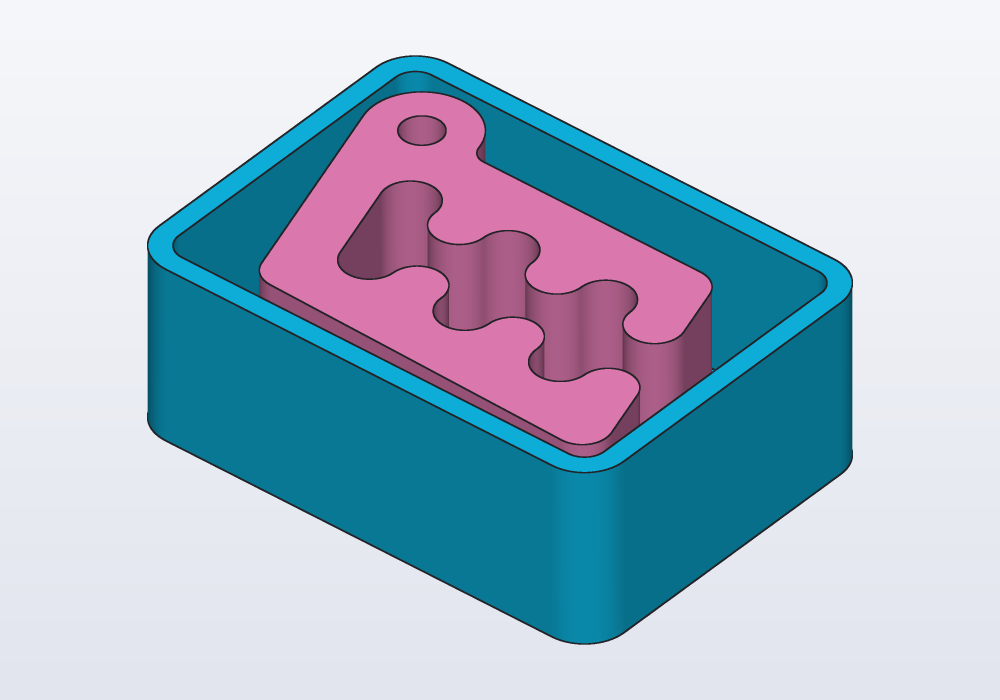
(holder() & inside()).volume is the material the two share: zero when Carlo does not run into the tray.
enclosure
enclosure(inner, …) returns a struct with two solids, .base and .lid, both standing on z = 0 and laid out to print:
- the base is a tray whose free space inside is
inner(x, y, z), so its outside isinner.x + 2 * wallbyinner.y + 2 * wall, andinner.z + walltall. In each corner stands a post with a pilot hole for the screw (screw.tap, ⌀2.5 for M3: a hole smaller than the screw, for a self-tapping screw that cuts its own thread, or for a tap) from the rim to the floor; - the lid is a plate as large as the base,
wallthick, with a lip on it: a ring that goeslidHeightdown inside the base withclearance(play, a small gap) all round, notched round the posts, so that the lid cannot slide sideways. It has a clearance hole (screw.clearance) over each post. It is made upside down, the plate on the ground, as it prints.
| Parameter | What it does | Default |
|---|---|---|
inner |
the free space inside, vec(x, y, z) |
— |
wall |
walls, floor and lid plate | 2.mm |
r |
radius of the vertical edges outside | 3.mm |
lidHeight |
how far the lip goes down into the base | 4.mm |
screw |
the screw size, from the hardware library (M2 to M12, the inch and the self-tapping sizes) |
M3 |
clearance |
play between the lip and the walls, and round the posts | 0.2.mm |
The screw sizes come with import std; too: pass M3 (or M2_5, M4…); the guide on holes lists the sizes and what each hole is for.
What the numbers mean once it is closed:
- the case is
inner.z + 2 * walltall, the lid's plate resting on the rim of the walls; - the lip takes the top
lidHeightof the inside along the walls,wallthick: anything taller thaninner.z - lidHeightmust staywall + clearanceaway from the walls; - the posts reach the rim, where the lid rests, the lip notched round them: the screw bites as soon as it is through the lid, so with the defaults an M3 × 8 goes 6 mm into the post;
- the screw heads stand on the lid; for heads flush with it, cut a counterbore (a wider, shallow hole that sinks the head) over each hole (
hole(M3, …, "counterbore"), see the guide on holes).
To see it closed, turn the lid over onto the base:
import std;

// the lid turned over onto the base, as it closes

immutable inner = vec(40.mm, 30.mm, 20.mm);
immutable wall = 2.mm;

@part("gold")
Solid base() => enclosure(inner, wall: wall).base;

@part("mediumseagreen")
Solid lid() => enclosure(inner, wall: wall).lid
    .rotate(x: 180.deg)
    .move(z: inner.z + 2 * wall);

unittest
{
    // closed, the lid and the base must not overlap
    assert((base() & lid()).volume == 0.mm ^^ 3);
}
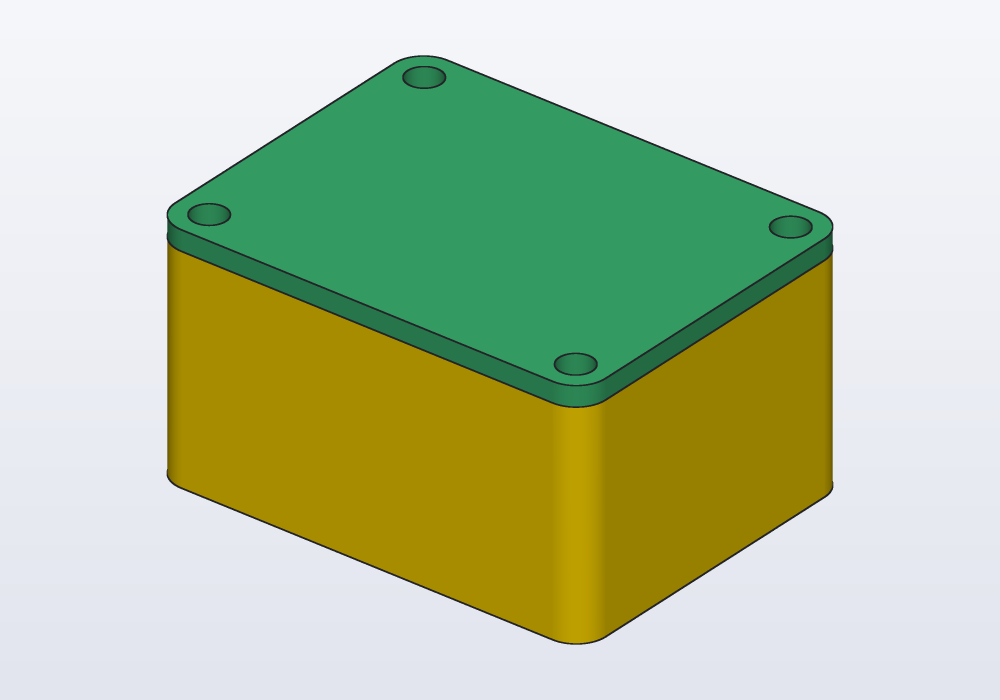
The library is a file of hackerscad code (lib/enclosures.hcad): when a case needs something it does not do, copy the function into the model and change it.
Shells: a box of any shape
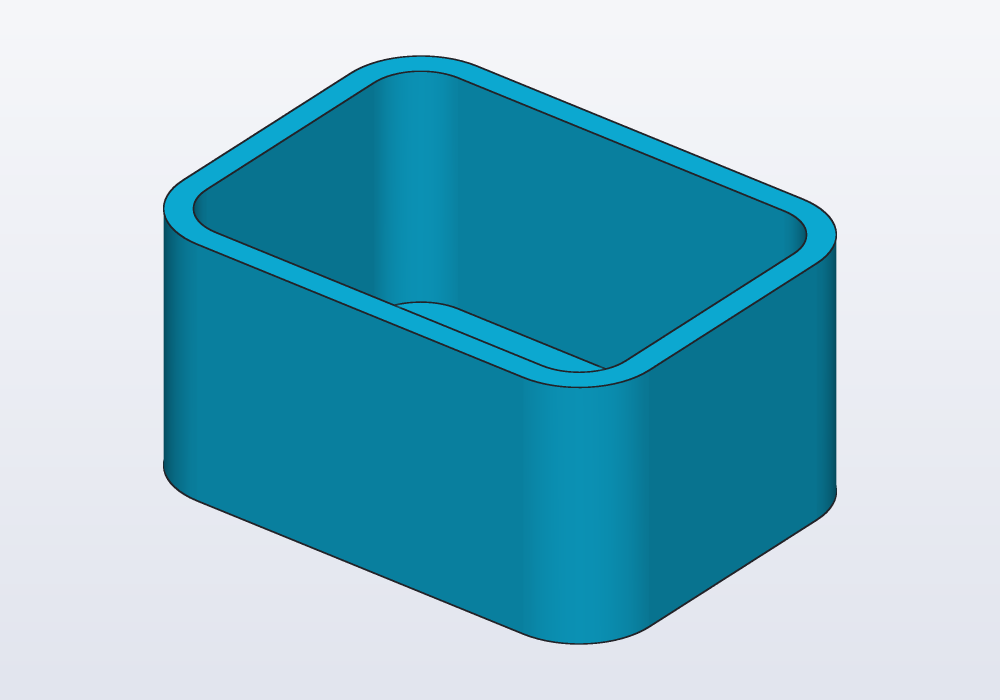
For a box of another shape (from a sketch, a loft that blends one outline into another, or with its edges rounded all round), make the solid first, then hollow it. solid.shell(open: faces, thickness:) hollows a solid, leaving the faces in open open and making walls thickness thick inwards: the outside stays where it was. The faces are selected as for any feature: faces.top, two at once with faces.top + faces.front, or by a filter. Round the edges (fillet them) before shelling: the inside follows the rounds of the outside.
// a box open on top, its edges rounded before the shell

@part("Sky Pop")
Solid cup() => box(40.mm, 30.mm, 20.mm)
    .fillet(edges.parallel(Z), r: 6.mm)
    .shell(open: faces.top, thickness: 2.mm);
A shell always has an opening. For a closed shape cut in two, a base and a lid that meet anywhere, hollow it with offset instead (the solid less a copy of itself shrunk by the wall), cut it with a plane into two halves (halves), and add a lip so the two halves sit in place:
// a soft box: every edge rounded, hollowed, cut in two

@param("Wall", min: 1.2.mm, max: 4.mm)
immutable wall = 2.mm;

@param("Play of the lid", min: 0.1.mm, max: 0.5.mm)
immutable play = 0.2.mm;

immutable cutZ = 22.mm;

Solid outside() => box(60.mm, 40.mm, 30.mm)
    .fillet(edges.parallel(Z), r: 8.mm)
    .fillet(edges.perpendicular(Z), r: 4.mm);

Solid hollow() => outside() - outside().offset(-wall);

Plane cut() => plane(origin: vec(0.mm, 0.mm, cutZ),
    normal: Z);

// a ring half a wall thick, inside the rim, 3 mm up
Solid lip() => (outside().offset(-wall)
        - outside().offset(-1.5 * wall))
    & box(100.mm, 100.mm, 6.mm).move(z: cutZ - 3.mm);

@part("Sky Pop")
Solid base() => hollow().halves(cut()).below + lip();

// the lid makes room for the lip, with some play
@part("Pink Pop")
Solid lid() => (hollow().halves(cut()).above
        - lip().offset(play))
    .move(z: 12.mm);
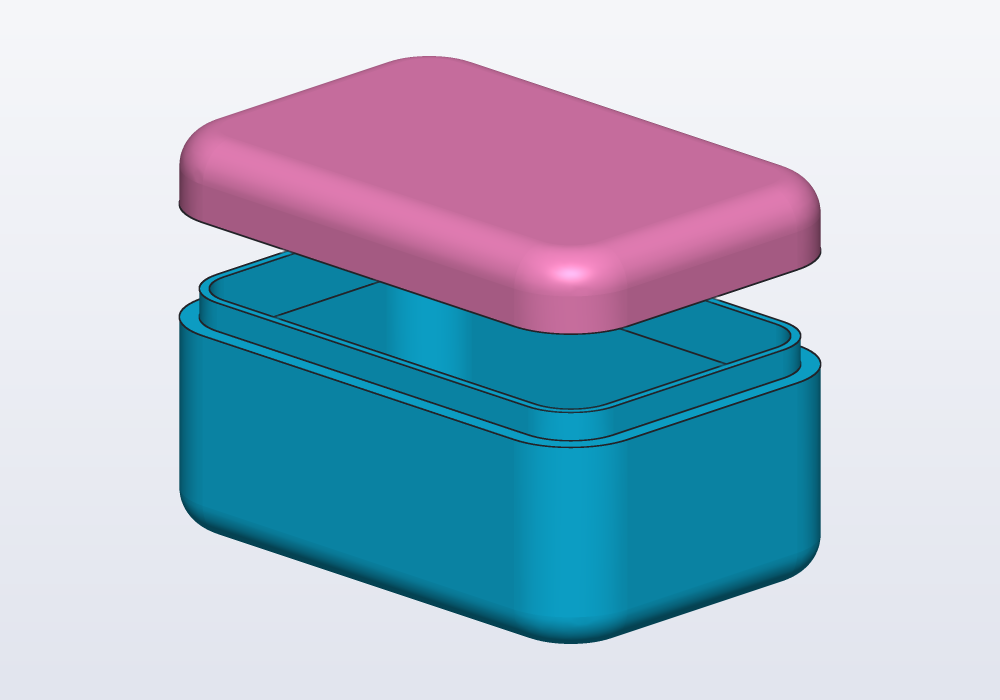
The lid is drawn lifted to show the lip; to print it, turn it over (.rotate(x: 180.deg)), its flat top on the bed.
A case round one part
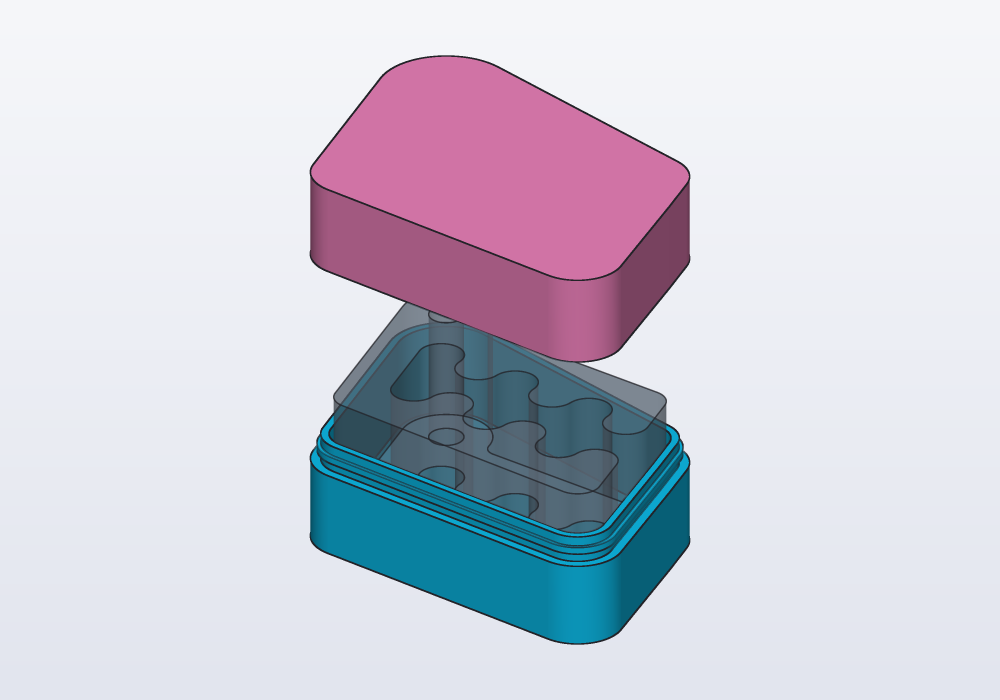
shadowCase makes a case that fits one part: its outline is the part's shadow seen from above (smoothed into a shape with no hollows), a little wider, and its walls go straight up, so the part drops in and lifts out. Base and lid meet halfway up the part, so once the lid is off the part stands out of the base and is easy to take.
import std;

// a case for Carlo; snap: the lid clicks shut
immutable c = shadowCase(carlo(), close: "snap");

@part("Sky Pop")
Solid base() => c.base;

// the lid lifted, to see inside
@part("Pink Pop")
Solid lid() => c.lid.move(z: 25.mm);

@part("slategray", alpha: 0.5, export: false)
Solid clip() => carlo();
| Parameter | What it does | Default |
|---|---|---|
on: |
the plane the shadow falls on, and the walls stand square to | the ground, XY |
wall: |
the walls' thickness | 2.mm |
clearance: |
the room between the part and the walls | 0.5.mm |
split: |
where base and lid meet, as a share of the part's height | 0.5, halfway |
close: |
"lip", a lip that holds by friction, or "snap", a bead on it that clicks into the lid |
"lip" |
lip: |
how high the lip rises into the lid | 3.mm, lower on a flat part |
play: |
how much narrower the lip is than the room for it | 0.2.mm |
On a flat part (a card, a coin, a board) a 3 mm lip would reach the lid's top: unless lip: is given, the lip is lower there, half the room over the cut. A lip: given that does not fit is an error.
The lip stands on the base, its inner face in line with the walls inside, and the lid's walls come down round it. The base's faces carry tags, as a tray's do: enclosures.floor the floor inside, enclosures.rim the top of the walls round the lip, where the lid rests, enclosures.lip the lip; the lid has none (faces.top of the lid turned over is its outside).
To put the part in standing up, turn it before: shadowCase(carlo().rotate(y: -90)) holds Carlo on its short side, in a tall narrow case. Print the lid on its flat top.
Screw bosses
A boss is a post that takes a screw, standing on the floor or a wall. The kind of hole decides its size; the guide on holes explains each one:
| Hole | In the boss | Boss diameter, about |
|---|---|---|
"tap" |
a pilot hole for a self-tapping screw (what enclosure() cuts) |
2.5 × the screw |
"insert" |
a heat-set brass insert, pressed in with a soldering iron: lasts many openings | the insert's hole + 3 mm |
"clearance" with a nut |
the screw goes through, a nut below (nutTrap) |
the nut + 3 mm |
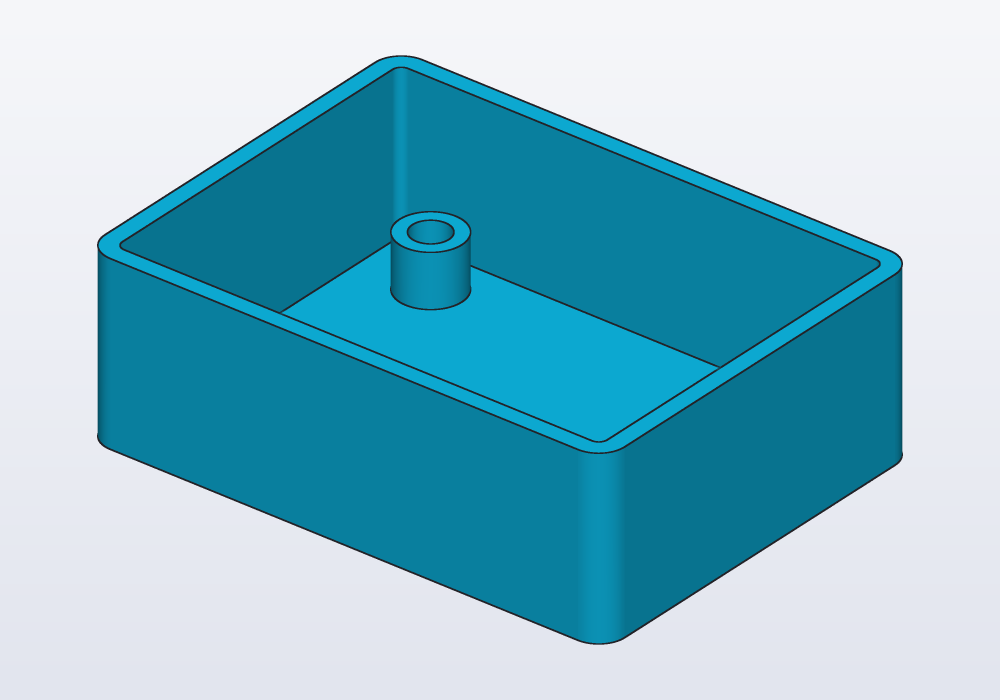
hole(screw, depth, kind) from hardware is a tool to subtract, its top on z = 0 going down: make the boss, then cut the hole from its top. Four bosses on a floor, with linearPattern (see the guide on patterns):
import std;

// four bosses for heat-set inserts, 40 × 30 mm apart

immutable floor = 2.mm;
immutable height = 6.mm;

Solid boss() => cylinder(d: M3.insert + 3.mm, h: height)
    - hole(M3, height, "insert").move(z: height);

@part("Sky Pop")
Solid holder() => tray(60.mm, 45.mm, 20.mm, wall: floor)
    + boss()
        .move(x: -20.mm, y: -15.mm, z: floor)
        .linearPattern(2, step: vec(40.mm, 0.mm, 0.mm))
        .linearPattern(2, step: vec(0.mm, 30.mm, 0.mm));
A tall boss in the open is weak: tie it to the nearest wall with a rib, or stand it in a corner as enclosure() does.
Ventilation
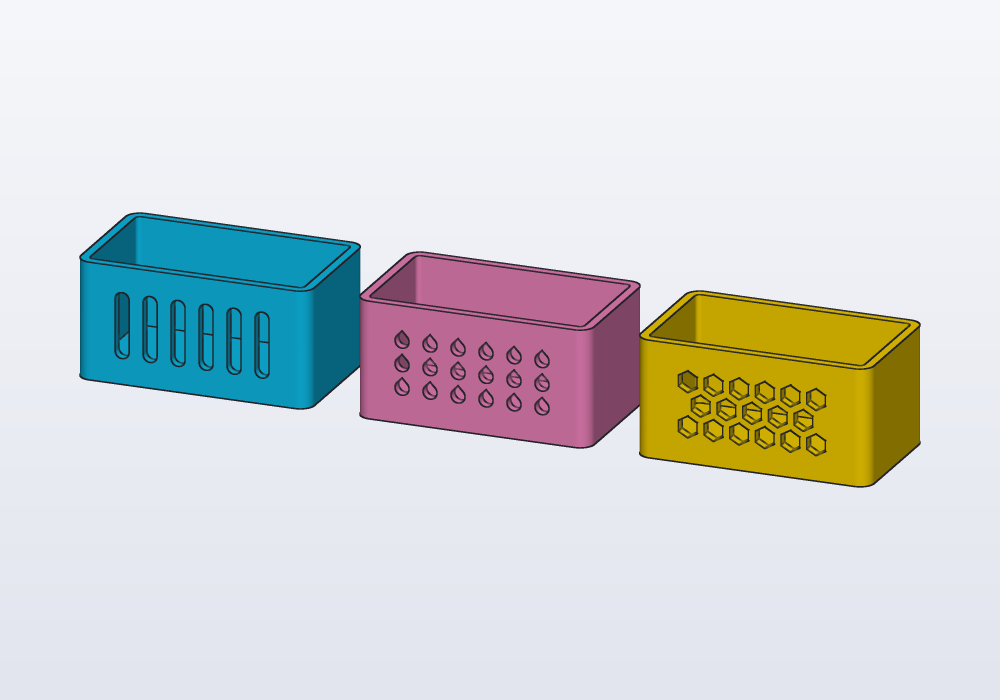
Air goes through slots and holes cut in a wall or in the lid. body.cut(profile, on: faces.front, depth: wall) cuts a profile into a face, centred on it (at: a point of the model moves it); several shapes are one profile, added up with + or collected in an array and joined with .sum.
import std;

// three ways to let air through a wall

Solid housing() => tray(50.mm, 30.mm, 25.mm,
    wall: 2.mm);

// upright slots print clean on a wall
Profile slots()
{
    Profile[] v;
    foreach (i; 0 .. 6)
        v ~= slot(14.mm, 3.mm, angle: 90.deg)
            .move(x: i * 6.mm - 15.mm);
    return v.sum;
}

// round holes across a wall: teardrops, point up
Profile drops()
{
    Profile[] v;
    foreach (i; 0 .. 6)
        foreach (j; 0 .. 3)
            v ~= teardrop(d: 3.mm)
                .move(x: i * 6.mm - 15.mm,
                    y: j * 5.mm - 5.mm);
    return v.sum;
}

// a honeycomb: every other row shifted half a cell
Profile honeycomb()
{
    Profile[] v;
    foreach (j; 0 .. 3)
        foreach (i; 0 .. 6 - j % 2)
            v ~= polygon(6, d: 4.mm, fit: "sides",
                    angle: 90.deg)
                .move(x: (i + j % 2 / 2.0) * 5.5.mm
                        - 13.75.mm,
                    y: (j - 1) * 4.8.mm);
    return v.sum;
}

@part("Sky Pop")
Solid slotted() => housing()
    .cut(slots(), on: faces.front, depth: 2.mm);

@part("Pink Pop")
Solid holed() => housing()
    .cut(drops(), on: faces.front, depth: 2.mm)
    .move(x: 60.mm);

@part("gold")
Solid hexed() => housing()
    .cut(honeycomb(), on: faces.front, depth: 2.mm)
    .move(x: 120.mm);
- Slots are the plainest: upright in a wall they print without supports; lying across a wall their tops sag a little, which a slot 3 mm wide survives.
- Round holes in a wall print with a drooping top: make them teardrops (
teardrop(d:)), point up. - A honeycomb opens the most area for the strength it leaves; hexagons with a corner up print in a wall as teardrops do.
- In the lid or the floor any shape prints well: those faces lie flat on the bed.
- Keep the bars between openings at least two lines of the nozzle (0.8 mm for 0.4 mm) and the openings under 3 mm where fingers or screwdrivers could reach the board.
- Air needs a way in and a way out: low on one side, high on the other, or the floor and the lid.
A worked example: a case for a circuit board
A case for a board with four mounting holes, a USB socket on a short side and vents in the lid. The sizes are made up: for a real board, measure them (below), and keep each one a @param to correct after a test print.
import std;

// a case for a 70 × 50 mm board: made-up sizes,
// measure your own

@param("Board length", min: 20.mm, max: 150.mm)
immutable boardX = 70.mm;

@param("Board width", min: 20.mm, max: 150.mm)
immutable boardY = 50.mm;

immutable boardZ = 1.6.mm;

// the mounting holes' centres, from the board's edges
immutable holeInset = 3.5.mm;

// the tallest part on top, and the height of the
// standoffs, which leaves room for the pins underneath
// and for the M3 inserts (5.7 mm long)
immutable above = 14.mm;
immutable standoff = 6.mm;

// room round the board, for the posts and the cables
@param("Room round the board", min: 2.mm, max: 20.mm)
immutable room = 6.mm;

immutable wall = 2.mm;

// a USB-C socket, its middle on the board's
immutable usbW = 9.mm;
immutable usbH = 3.2.mm;

Vec3 inner() => vec(boardX + 2 * room,
    boardY + 2 * room, standoff + boardZ + above);

Enclosure housing() => enclosure(inner(),
    wall: wall, screw: M3);

// the board's top, measured from the ground
Length boardTop() => wall + standoff + boardZ;

Vec2[] holeCentres()
{
    immutable hx = boardX / 2 - holeInset;
    immutable hy = boardY / 2 - holeInset;
    return [vec(-hx, -hy), vec(hx, -hy),
        vec(-hx, hy), vec(hx, hy)];
}

Solid standoffs()
{
    Solid all;
    foreach (c; holeCentres())
    {
        auto post = cylinder(d: M3.insert + 3.mm,
                h: standoff)
            - hole(M3, standoff, "insert")
                .move(z: standoff);
        all += post.move(x: c.x, y: c.y, z: wall);
    }
    return all;
}

// the socket's opening, 0.5 mm of play all round
Profile usb() => rect(usbW + 1.mm, usbH + 1.mm,
    corner: 1.mm);

@part("Sky Pop")
Solid base() => (housing().base + standoffs())
    .cut(usb(), on: faces.left,
        at: vec(0.mm, 0.mm, boardTop() + usbH / 2),
        depth: wall);

// slots over the middle of the board, in the lid
Profile vents()
{
    Profile[] v;
    foreach (i; 0 .. 6)
        v ~= slot(30.mm, 3.mm, angle: 90.deg)
            .move(x: i * 6.mm - 15.mm);
    return v.sum;
}

@part("Pink Pop")
Solid lid() => housing().lid
    .cut(vents(), on: faces.bottom, depth: wall)
    .move(y: inner().y + 15.mm);

// the board itself, to see that it fits: not printed
@part("seagreen", alpha: 0.4, export: false)
Solid board()
{
    auto b = box(boardX, boardY, boardZ);
    foreach (c; holeCentres())
        b -= cylinder(d: 3.2.mm, h: 5.mm, center: true)
            .move(x: c.x, y: c.y);
    return b.move(z: wall + standoff);
}

unittest
{
    assert((base() & board()).volume == 0.mm ^^ 3,
        "the board must not run into the box");
}
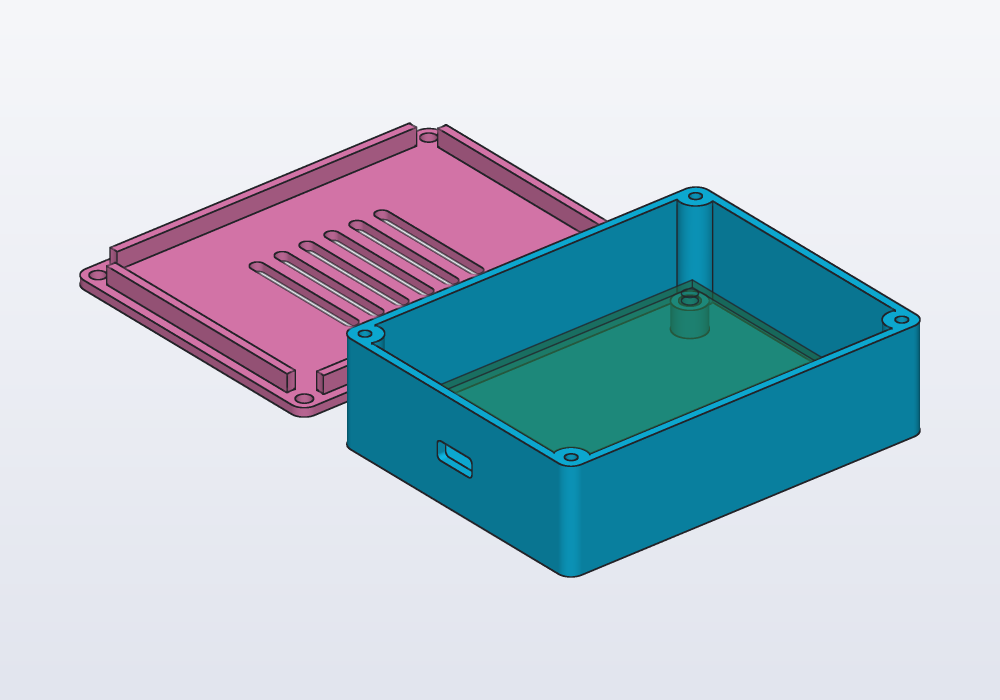
How it is built, step by step:
- The space inside is the board plus
roomon every side, and as tall as the standoffs, the board and its tallest part:inner(). Everything else follows from it. enclosure()makes the base and the lid round that space, with M3 posts in the corners. The room round the board keeps its corners clear of the posts; the unittest checks it: withroomat 2 mm,hcad checkstops with the board must not run into the box.- Standoffs (short posts) under the board's holes, with heat-set inserts, lift it off the floor: the solder joints underneath need the room.
- The opening for the socket is a rounded rectangle cut into the left wall, at the height of the socket's middle (
at:), with 0.5 mm of play all round. - Vents are cut into the lid's plate from its outer face (
faces.bottom, as the lid is laid out to print). - The board is a see-through part that is not exported: it shows the fit and lets a unittest test it.
What to measure on a real board, with calipers:
- the board's length, width and thickness;
- the mounting holes: their diameter, and their centres from two edges (the distance between two holes' centres, axis to axis, is the more accurate);
- the tallest part on top, and how far the pins stick out underneath;
- each connector: which edge, its width and height, its middle from a corner of the board, and how far it overhangs the edge;
- buttons, LEDs and displays to reach or see through the lid: their position from the same corner.
Printing boxes
- The base prints as it is made, open side up. The lid of
enclosure()prints as it is made too, plate on the bed and lip up: neither needs supports. - A wall of 2 mm is five lines of a 0.4 mm nozzle; under 1.2 mm a box flexes and a screw post cracks.
--printabilityonhcad render(andassert(part.thinWalls == 0.mm ^^ 2)in a unittest) finds walls thinner than a limit. - A lip fits with 0.2 mm of play on most printers (
clearance:): print a corner of it first, and keep the play a@param(see the guide on fits). - Holes across a wall: teardrops, point up. Slots and openings with a flat top wider than about 10 mm sag: round their tops, or let the lid close them.
- Long, flat boxes warp at the corners in ABS and PETG: round the vertical edges (
r) generously.
Common errors
| Message | What to do |
|---|---|
| shell failed: the kernel could not hollow this solid: the wall must be thinner than the smallest fillet radius… | a thinner wall |
| a wall of 25 mm leaves nothing inside a part 20 mm thin | the wall is thicker than the part: a thinner one |
| every face is open: nothing would be left to make the walls of | the selector in open: took every face: select only the openings |
| missing argument 'open' for shell(solid, open, thickness) | a shell needs an opening; for a closed hollow, subtract offset(-wall) as above |
| roundedBox: r must be more than 0 and less than half the shorter side | a smaller radius |
| tray: a wall as thick as r leaves sharp inside corners that cannot be built… | a larger r (or a thicker wall) |
| enclosure: the lid's lip (lidHeight) must be lower than the inside (inner.z) | a shorter lip or a taller box |
| shadowCase: the lip reaches the lid's top: a shorter lip, or split lower | the lip: given is too high for the part: a lower one, or leave it out |
| undefined identifier 'M3' | import std; at the top |
In the application
- Examples › Box with lid opens a box with a lid to choose (snap, lip, screws, flush) and its parameters: a good start to change.
- In the 3D view, pick faces (Alt+2) and right-click: Hollow › Shell, opening this face… (or opening N faces) writes
.shell(open: …, thickness: 2.mm)with the selected faces. Fillet the edges first (Edges › Fillet face edges…). - Right-click a face, at the point where it goes: At this point › Hole › Clearance or Tapping › M2 to M12 writes a
.cut(circle(d: …), on: …, at: …, depth: 5.mm), Heat-set insert, Counterbore, Countersink or Ribs a.cut(hole(M3, 6.mm, "insert"), on: …, at: …)(5 mm deep, or as deep as an insert or a head's seat needs); At this point › Boss… an.extrude(circle(d: 6.mm), …); At this point › Pocket… a rectangular pocket. Change the sizes in the code. - The
@params of the case (the board's size, the room, the play) are sliders in the Parameters panel: the case follows.