Flexible parts and hinges
Parts that bend where they should: a rigid plate made to bend in a band by rows of slots (kerf bending), and the hinges of the hinges library, four kinds, all printed flat without supports.
// a plate made to bend in a band across its middle, and
// a tube made to bow in a band round it

import std;

@part("Sky Pop")
Solid plate() => kerf(box(120.mm, 40.mm, 3.mm),
    box(40.mm, 50.mm, 10.mm, center: true));

@part("Pink Pop")
Solid tube() => kerf(cylinder(d: 30.mm, h: 60.mm)
        - cylinder(d: 26.mm, h: 70.mm, center: true),
    box(40.mm, 10.mm, 30.mm).move(y: -15.mm, z: 15.mm))
    .move(x: 90.mm);
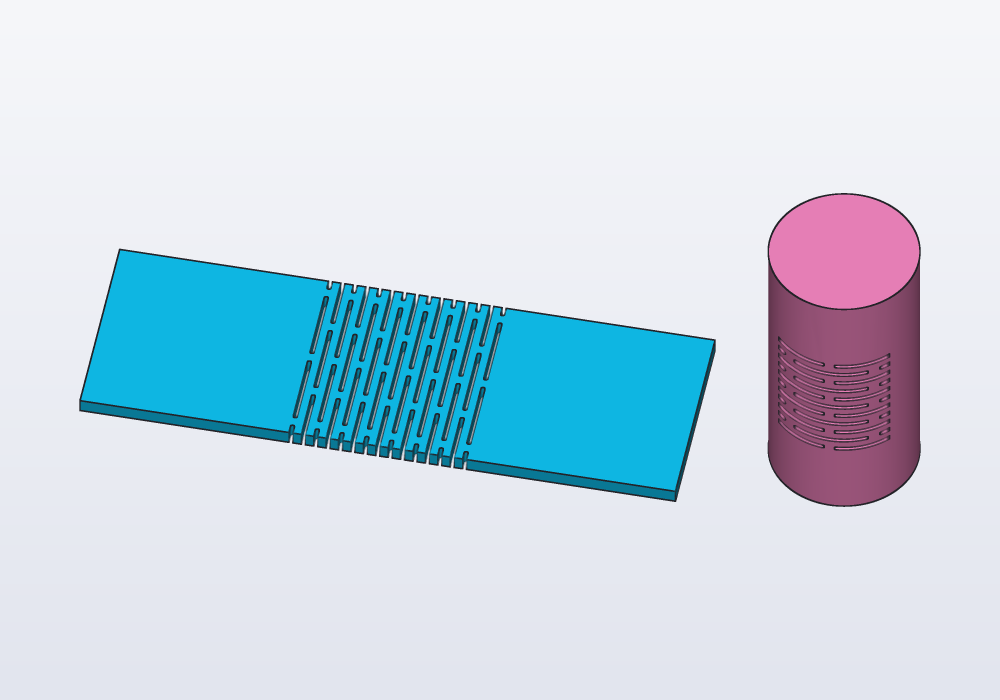
Kerf bending
kerf(body, zone) makes body bend where it lies inside zone: any solid, a box across a plate, a ring round a tube. Rows of slots go through the part, each row shifted half a slot from the next; what is left between them is a lattice of thin bars, each of which twists a little, and together they bend far.
- The slots go through the part's thinnest way inside the zone (a plate's thickness, a tube's wall).
- They run across the body's length, so the part bends along it: a strip end to end, a tube bowing.
along: X(orY,Z) sets the way they run instead, whenever the guess is not what you want. - They run along X, Y or Z only, and go through along one of them: a plate lying turned at an angle gets them across it askew. Make the part bend lying along the axes, then turn it.
- Slots that would cut the part in pieces are an error: shorter ones (
length:) or wider bridges.
| Argument | What it does |
|---|---|
width: |
how wide each slot is, 0.8 mm unless given: two lines of a 0.4 mm nozzle leave it open |
bridge: |
the material between two slots of a row, 2 mm unless given: the narrower, the softer it bends |
pitch: |
from one row to the next, 2.5 mm unless given: the closer, the tighter it bends; the bars are pitch less width thick |
length: |
of each slot, six times the pitch unless given; on a narrow strap the strap's width less a bridge, so every other row keeps material at both ends |
along: |
the way the slots run |
How far a band bends depends on the material: in PLA a few degrees a row, and it may crack if bent often; PETG takes a quarter turn in a band of 15 mm with bars 1 mm thick; TPU folds flat. Print the part lying on its flat side, the slots standing upright.
A strip with four bands folds into the walls of a box: half a wall, then wall and band in turn, then the other half wall, its ends locked edge to edge with jigsaw tabs, and its bottom edge dropped into a groove in a base. A band of width b bent through 90° makes a quarter circle of radius 2 b / π on the wall's middle: the corners of the groove.
Hinges
// a living hinge, a hinge on a separate pin, and one
// that snaps together; the print-in-place hinge() is the
// fourth kind

import std;

@part("Sky Pop")
Solid living() => livingHinge();

@part("Pink Pop")
Solid pinFixed() => pinHinge().fixed.move(x: 55.mm);

@part("gold")
Solid pinMoving() => pinHinge().moving.move(x: 55.mm);

@part("Sky Pop")
Solid snapFixed() => snapHinge().fixed.move(x: 105.mm);

@part("mediumseagreen")
Solid snapMoving() => snapHinge().moving.move(x: 105.mm);
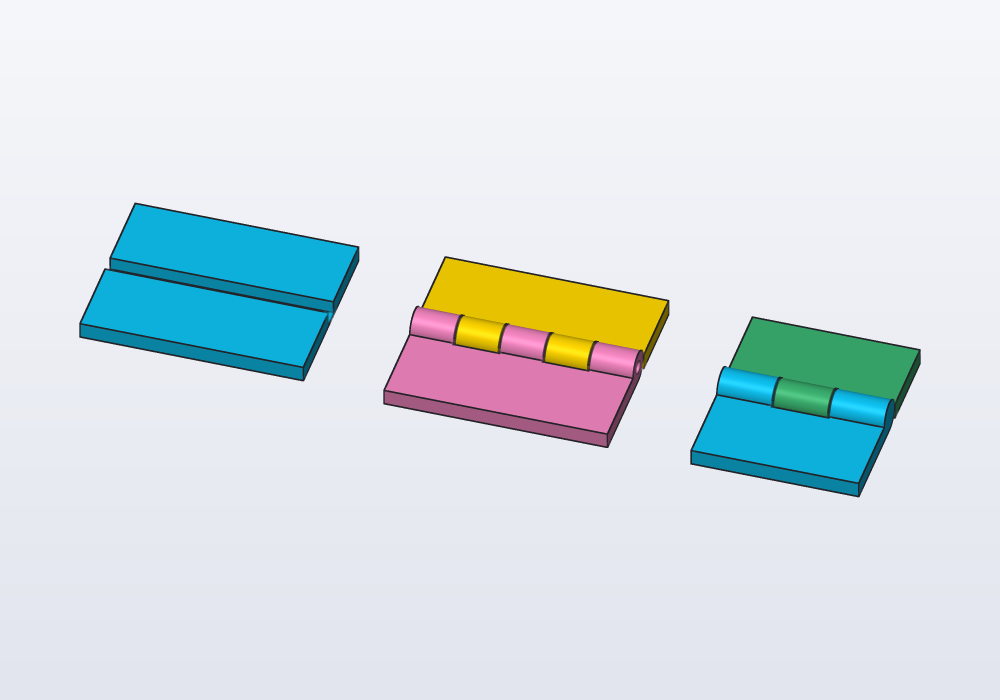
| Hinge | What it is | How it is made | Comes apart |
|---|---|---|---|
hinge() |
knuckles round a pin of the fixed leaf, printed already joined | in place, flat, 0.4 mm of play round the pin | no |
pinHinge() |
knuckles holed for a separate pin: a length of 1.75 mm filament, a nail, a screw | the leaves apart, flat; the pin pushed through | yes |
snapHinge() |
three knuckles, the outer two with cones that click into sockets in the middle one | the leaves apart, flat; the outer knuckles sprung apart to fit | yes |
livingHinge() |
two plates joined by a thin web on their underside | flat, the web on the bed, its layers across the fold; PETG, PP or TPU | no, one piece |
Every hinge returns its leaves laid round an axis along X at the height of their thickness (the living hinge: one piece, the fold along X): place the leaves on the parts they join, or join them to the parts with +. Both leaves carry that axis, tagged hinges.axis, wherever they are placed (leaf.axis("hinges.axis"): to turn one about it), and a pin hinge's holes are tagged hinges.pin.
- A print-in-place hinge needs the play (
clearance:) your printer can leave open: print one before a whole box. - A pin of filament holds well when its hole is 0.2 to 0.3 mm larger; melt its ends a little with a soldering iron to keep it in.
- The snap hinge's cones lean at 45°: they print without supports and spring in and out without breaking. Thicker leaves, a stiffer snap.
- A living hinge's web 0.4 to 0.6 mm thick (one or two layers of 0.3 mm, or several of 0.1 mm) bends thousands of times in PP, hundreds in PETG.
Common errors
| Message | What to do |
|---|---|
| kerf: the zone does not meet the body | move the zone onto the part |
| kerf: the slots cannot run along the way they go through | along: one of the other two axes |
| the part bends the wrong way | along: the other axis in its plane |
| undefined identifier 'kerf' | import std; at the top |