Molds for casting
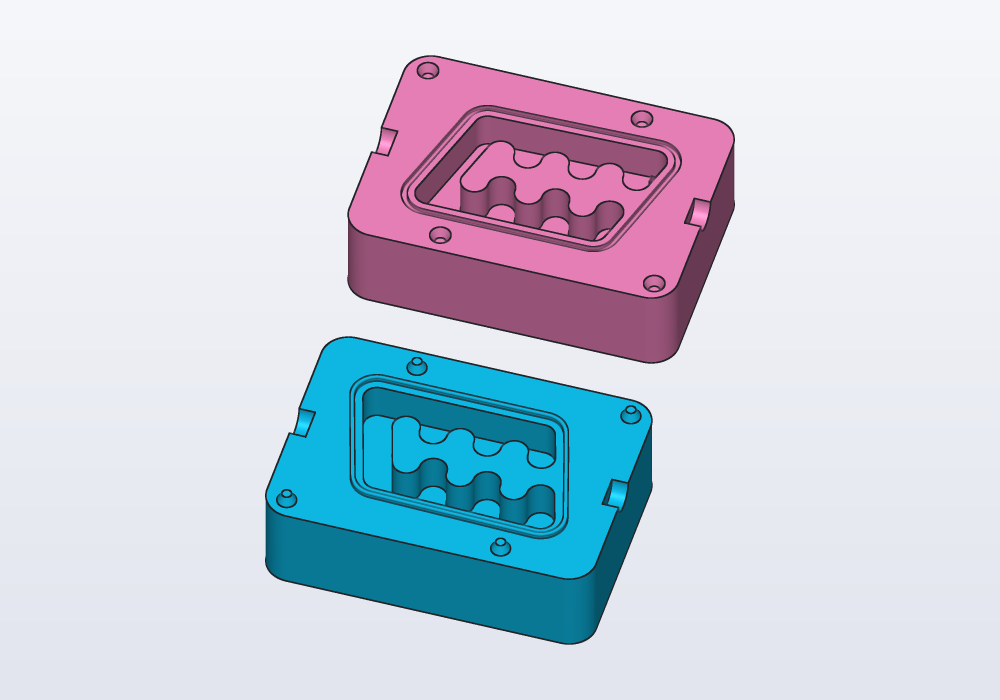
A two-part mold to cast copies of a part in silicone, resin or plaster: a block round the part, cut in two along a parting plane, the part's shape hollow inside, with keys that line the halves up, a seal round the cavity so the liquid stays in, and a pour hole with vents for the air. The molds library makes it from the part itself.
// a mold to cast Carlo in silicone (without its eye, a
// thin core that would tear the cast), open: the lower
// half with its keys and the seal, the upper turned over

import std;

Mold carloMold() => mold(carlo(eye: false),
    plane(origin: vec(0.mm, 0.mm, 7.5.mm), normal: Z));

@part("Sky Pop")
Solid lower() => carloMold().a;

@part("Pink Pop")
Solid upper() => carloMold().b
    .rotate(x: 180)
    .move(y: 50.mm, z: 35.mm);
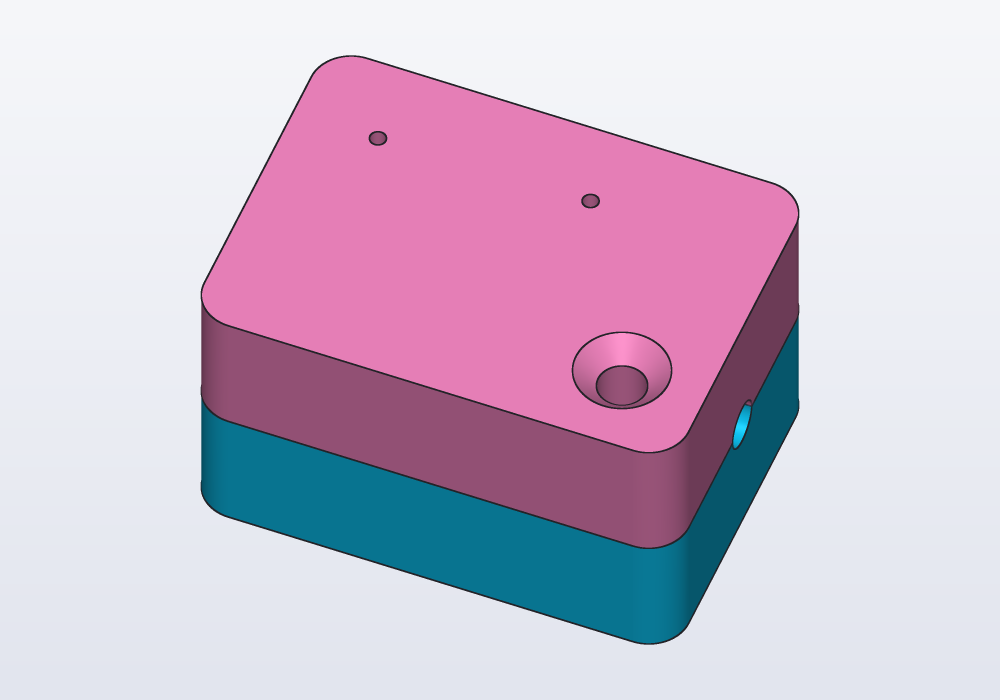
Closed, the mold shows the pour hole, its funnel and the two vents on top, and the notches to pry it open on the sides:
// the same mold closed, as it stands to be poured: the
// funnel and the vents on top

import std;

Mold carloMold() => mold(carlo(eye: false),
    plane(origin: vec(0.mm, 0.mm, 7.5.mm), normal: Z));

@part("Sky Pop")
Solid lower() => carloMold().a;

@part("Pink Pop")
Solid upper() => carloMold().b;
The mold
mold(part, plane) gives a Mold: the halves where they go (.a behind the plane, .b in front of it) and laid for printing (.aPrint, .bPrint). The block is wall thick round the part (10 mm unless given), square to the parting plane even when that is slanted, and rounded at its edges across it.
The parting plane decides whether the cast comes out: it must cross the part where it is widest, so that nothing of the part hides behind something else seen from either side. A part lying flat (Carlo) parts at half its height; an egg or a figure parts through its middle, along its length.
- Keys line the halves up: truncated cones on
a's parting face, their sockets inb's,clearancelarger (0.15 mm unless given), as many askeys:(4 unless given;count:is the same, as in the joints library), placed where the face has room, as far apart as they can be. - The seal keeps the liquid from creeping out between the halves: a ridge round the cavity (round its convex hull, so it stays one smooth loop past notches) on
a,sealhigh (0.8 mm unless given), pressing into a groove inb.seal: 0.mmleaves it out. - Notches across the parting line on two opposite sides take a flat screwdriver to open the mold without marring its faces;
pry: falseleaves them out. - The pour hole goes up through
bfrom just under the cavity's top, along the plane's normal,spruewide (6 mm unless given) and opening into a funnel at the block's face;vents:thinner channels (2 unless given) let the air out from other high points. Pour withbon top. - Tags name the faces you may want to work on:
molds.cavitythe hollow (a draft, a texture),molds.partingthe faces on the parting plane,molds.spruethe pour hole. See Selectors and features.
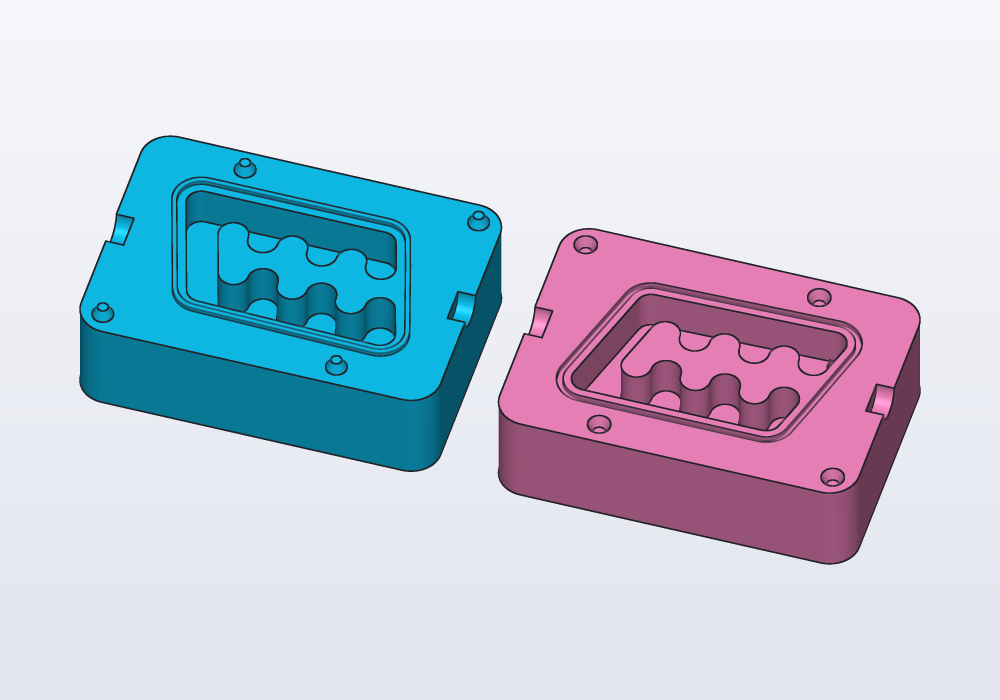
Each half prints on its outer face, the parting face up: the keys and the seal stand up, the sockets, the groove and the cavity open upwards, and nothing needs supports.
// the same mold laid for printing: both halves on their
// outer faces, the parting faces up

import std;

Mold carloMold() => mold(carlo(eye: false),
    plane(origin: vec(0.mm, 0.mm, 7.5.mm), normal: Z));

@part("Sky Pop")
Solid lower() => carloMold().aPrint;

@part("Pink Pop")
Solid upper() => carloMold().bPrint.move(x: 70.mm);
Casting
- Print the halves with fine layers where the cavity is (they show on the cast) and 100% infill round it, or the block flexes under clamps.
- Smooth the cavity if the surface matters: layer lines print onto the cast. A coat of primer, sanded, or XTC-3D does it.
- Silicone does not stick to PLA or PETG, but platinum silicone cures badly against some resins and fresh prints: test a drop first, or seal the mold with a varnish. For resin or plaster casts, a mold release.
- Clamp the halves or tape them round, pour slowly into the funnel until the liquid shows in the vents, and tap the mold to bring up the bubbles.
- A paste that does not pour (oogoo, silicone sealant kneaded with corn starch; a putty) is pressed into both open halves, a little more than they hold, then the mold is closed and clamped: the pour hole and the vents let the extra out. Such pastes cure from the outside in, with the air's moisture: give a part 15 mm thick a night.
- Open it at the notches with a flat screwdriver.
Common errors
| Message | What to do |
|---|---|
| mold: no room for the keys on the parting face | a thicker wall:, fewer keys:, or seal: 0.mm |
| the cast does not come out | the parting plane does not cross the part where it is widest: move it, or turn it |
| undefined identifier 'mold' | import std; at the top |
In the application
- The halves are ordinary parts: export them together (one bed) or each on its own.
- A section through the mold shows the cavity, the seal and the keys at once: see Planes.